
Note
Go to the end to download the full example code.
SVM and GAK#
This example illustrates the use of the global alignment kernel (GAK) for support vector classification.
This metric is defined in the tslearn.metrics module and explained in details in [1].
In this example, a TimeSeriesSVC model that uses GAK as kernel is fit and the support vectors for each class are reported.
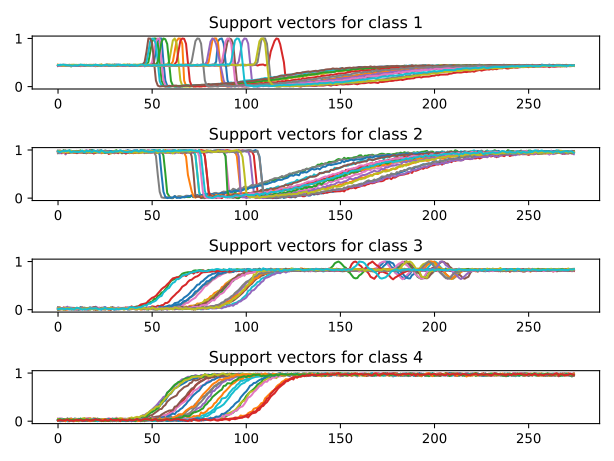
Correct classification rate: 1.0
# Author: Romain Tavenard
# License: BSD 3 clause

import numpy
import matplotlib.pyplot as plt

from tslearn.datasets import CachedDatasets
from tslearn.preprocessing import TimeSeriesScalerMinMax
from tslearn.svm import TimeSeriesSVC

numpy.random.seed(0)
X_train, y_train, X_test, y_test = CachedDatasets().load_dataset("Trace")
X_train = TimeSeriesScalerMinMax().fit_transform(X_train)
X_test = TimeSeriesScalerMinMax().fit_transform(X_test)

clf = TimeSeriesSVC(kernel="gak", gamma=.1)
clf.fit(X_train, y_train)
print("Correct classification rate:", clf.score(X_test, y_test))

n_classes = len(set(y_train))

plt.figure()
support_vectors = clf.support_vectors_
for i, cl in enumerate(set(y_train)):
    plt.subplot(n_classes, 1, i + 1)
    plt.title("Support vectors for class %d" % cl)
    for ts in support_vectors[i]:
        plt.plot(ts.ravel())

plt.tight_layout()
plt.show()
Total running time of the script: (0 minutes 8.916 seconds)