TimeSeriesScalerMinMax#
- class tslearn.preprocessing.TimeSeriesScalerMinMax(value_range=(0.0, 1.0), per_timeseries=True, per_feature=True)[source]#
Scaler for time series datasets. When per_timeseries is False, scales features based on computation led on the fitted data, so that their span in given dimensions is between
minandmaxwherevalue_range=(min, max). The transformation is stateless otherwise, dealing with each timeseries individually.- Parameters:
- value_rangetuple (default: (0., 1.))
The minimum and maximum value for the output time series.
- per_timeseries: bool (default: True)
Wether the scaling should be performed per time series.
- per_feature: bool (default: True)
Wether the scaling should be performed per feature. Meaningless for univariate timeseries.
Notes
NaNs within a time series are ignored when calculating min and max.
Examples
>>> TimeSeriesScalerMinMax(value_range=(1., 2.)).fit_transform([[0, 3, 6]])
array([[[1. ],
        [1.5],
        [2. ]]])
>>> TimeSeriesScalerMinMax(value_range=(1., 2.)).fit_transform(
...     [[numpy.nan, 3, 6]]
... )
array([[[nan],
        [ 1.],
        [ 2.]]])
>>> TimeSeriesScalerMinMax(value_range=(1., 2.), per_timeseries=False, per_feature=False).fit_transform(
...    [[[1, 2], [2, 3]],
...    [[3, 4], [4, 5]]]
... )
array([[[1.  , 1.25],
        [1.25, 1.5 ]],

       [[1.5 , 1.75],
        [1.75, 2.  ]]])
Methods
fit(X[, y])Computes the min and max to be used for later scaling if per_timeseries is False.
fit_transform(X[, y])Fit to data, then transform it.
Get metadata routing of this object.
get_params([deep])Get parameters for this estimator.
set_output(*[, transform])Set output container.
set_params(**params)Set the parameters of this estimator.
transform(X[, y])Normalizes (min-max) the dataset.
- fit(X, y=None, **kwargs)[source]#
Computes the min and max to be used for later scaling if per_timeseries is False. Just performs dimension checks otherwise.
- Parameters:
- Xarray-like of shape (n_ts, sz, d)
Time series dataset reference.
- Returns:
- self
- fit_transform(X, y=None, **kwargs)[source]#
Fit to data, then transform it.
- Parameters:
- Xarray-like of shape (n_ts, sz, d)
Time series dataset to be rescaled.
- Returns:
- numpy.ndarray
Resampled time series dataset.
- get_metadata_routing()#
Get metadata routing of this object.
Please check User Guide on how the routing mechanism works.
- Returns:
- routingMetadataRequest
A
MetadataRequestencapsulating routing information.
- get_params(deep=True)#
Get parameters for this estimator.
- Parameters:
- deepbool, default=True
If True, will return the parameters for this estimator and contained subobjects that are estimators.
- Returns:
- paramsdict
Parameter names mapped to their values.
- set_output(*, transform=None)#
Set output container.
See Introducing the set_output API for an example on how to use the API.
- Parameters:
- transform{“default”, “pandas”, “polars”}, default=None
Configure output of transform and fit_transform.
“default”: Default output format of a transformer
“pandas”: DataFrame output
“polars”: Polars output
None: Transform configuration is unchanged
Added in version 1.4: “polars” option was added.
- Returns:
- selfestimator instance
Estimator instance.
- set_params(**params)#
Set the parameters of this estimator.
The method works on simple estimators as well as on nested objects (such as
Pipeline). The latter have parameters of the form<component>__<parameter>so that it’s possible to update each component of a nested object.- Parameters:
- **paramsdict
Estimator parameters.
- Returns:
- selfestimator instance
Estimator instance.
- transform(X, y=None, **kwargs)[source]#
Normalizes (min-max) the dataset. If per_timeseries is True, this transformation is completely stateless, and is applied to each of the timeseries individually. Otherwise, normalization is performed based on the fitted data.
- Parameters:
- Xarray-like of shape (n_ts, sz, d)
Time series dataset to be rescaled.
- Returns:
- numpy.ndarray
Rescaled time series dataset.
Examples using tslearn.preprocessing.TimeSeriesScalerMinMax#
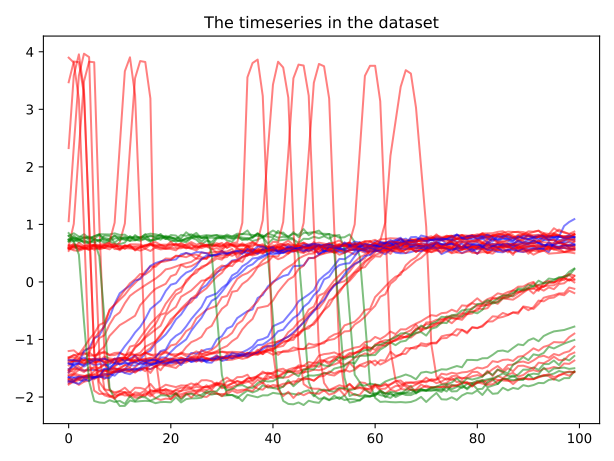
Hyper-parameter tuning of a pipeline with KNeighbors time series classifier

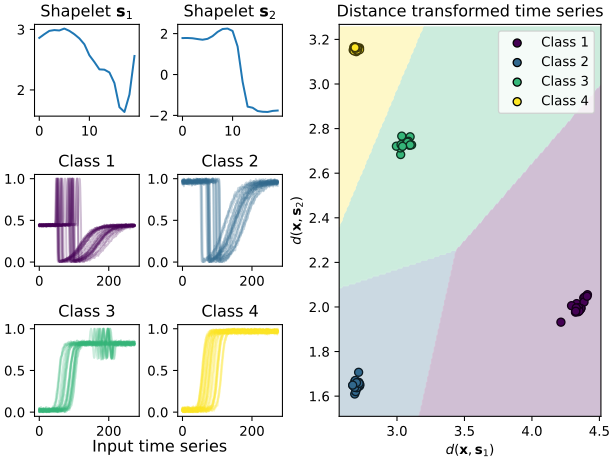
Learning Shapelets: decision boundaries in 2D distance space