TimeSeriesScalerMeanVariance#
- class tslearn.preprocessing.TimeSeriesScalerMeanVariance(mu=0.0, std=1.0, per_timeseries=True, per_feature=True)[source]#
Scaler for time series datasets. When per_timeseries is False, scales features based on computation led on the fitted data, so that their mean (resp. standard deviation) in given dimensions is mu (resp. std). The transformation is stateless otherwise, dealing with each timeseries individually.
- Parameters:
- mufloat (default: 0.)
Mean of the output time series.
- stdfloat (default: 1.)
Standard deviation of the output time series.
- per_timeseries: bool (default: True)
Whether the scaling should be performed per time series.
- per_feature: bool (default: True)
Whether the scaling should be performed per feature. Meaningless for univariate timeseries.
Notes
NaNs within a time series are ignored when calculating mu and std.
Examples
>>> TimeSeriesScalerMeanVariance(mu=0.,
...                              std=1.).fit_transform([[0, 3, 6]])
array([[[-1.22474487],
        [ 0.        ],
        [ 1.22474487]]])
>>> TimeSeriesScalerMeanVariance(mu=0.,
...                              std=1.).fit_transform([[numpy.nan, 3, 6]])
array([[[nan],
        [-1.],
        [ 1.]]])
>>> TimeSeriesScalerMeanVariance(per_timeseries=False,
...                              per_feature=False
... ).fit_transform([[[1, 2], [2, 3]], [[3, 4], [4, 5]]])
array([[[-1.63299316, -0.81649658],
        [-0.81649658,  0.        ]],

       [[ 0.        ,  0.81649658],
        [ 0.81649658,  1.63299316]]])
Methods
fit(X[, y])Computes the mean and standard deviation to be used for later scaling if per_timeseries is False.
fit_transform(X[, y])Fit to data, then transform it.
Get metadata routing of this object.
get_params([deep])Get parameters for this estimator.
set_output(*[, transform])Set output container.
set_params(**params)Set the parameters of this estimator.
transform(X[, y])Normalizes (mean-std) the dataset.
- fit(X, y=None, **kwargs)[source]#
Computes the mean and standard deviation to be used for later scaling if per_timeseries is False. Just performs dimension checks otherwise.
- Parameters:
- Xarray-like of shape (n_ts, sz, d)
Time series dataset reference.
- Returns:
- self
- fit_transform(X, y=None, **kwargs)[source]#
Fit to data, then transform it.
- Parameters:
- Xarray-like of shape (n_ts, sz, d)
Time series dataset to be rescaled.
- Returns:
- numpy.ndarray
Resampled time series dataset.
- get_metadata_routing()#
Get metadata routing of this object.
Please check User Guide on how the routing mechanism works.
- Returns:
- routingMetadataRequest
A
MetadataRequestencapsulating routing information.
- get_params(deep=True)#
Get parameters for this estimator.
- Parameters:
- deepbool, default=True
If True, will return the parameters for this estimator and contained subobjects that are estimators.
- Returns:
- paramsdict
Parameter names mapped to their values.
- set_output(*, transform=None)#
Set output container.
See Introducing the set_output API for an example on how to use the API.
- Parameters:
- transform{“default”, “pandas”, “polars”}, default=None
Configure output of transform and fit_transform.
“default”: Default output format of a transformer
“pandas”: DataFrame output
“polars”: Polars output
None: Transform configuration is unchanged
Added in version 1.4: “polars” option was added.
- Returns:
- selfestimator instance
Estimator instance.
- set_params(**params)#
Set the parameters of this estimator.
The method works on simple estimators as well as on nested objects (such as
Pipeline). The latter have parameters of the form<component>__<parameter>so that it’s possible to update each component of a nested object.- Parameters:
- **paramsdict
Estimator parameters.
- Returns:
- selfestimator instance
Estimator instance.
- transform(X, y=None, **kwargs)[source]#
Normalizes (mean-std) the dataset. If per_timeseries is True, this transformation is completely stateless, and is applied to each of the timeseries individually. Otherwise, normalization is performed based on the fitted data.
- Parameters:
- Xarray-like of shape (n_ts, sz, d)
Time series dataset to be rescaled.
- Returns:
- numpy.ndarray
Rescaled time series dataset.
Examples using tslearn.preprocessing.TimeSeriesScalerMeanVariance#
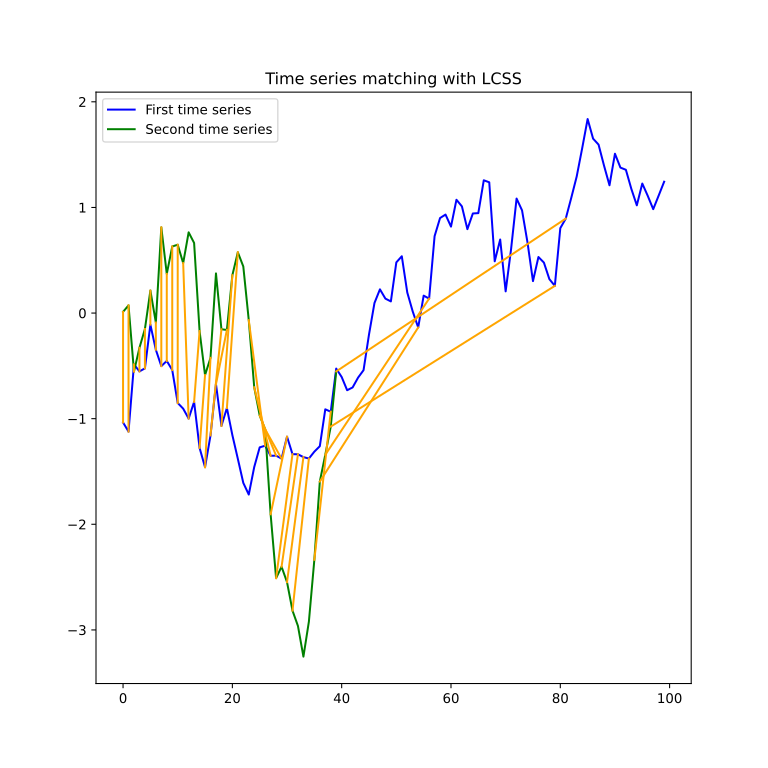

Longest Common Subsequence with a custom distance metric