PiecewiseAggregateApproximation#
- class tslearn.piecewise.PiecewiseAggregateApproximation(n_segments=1)[source]#
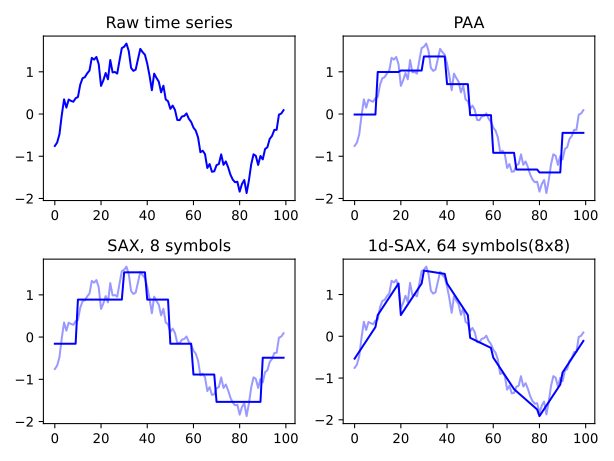
Piecewise Aggregate Approximation (PAA) transformation.
PAA was originally presented in [1].
- Parameters:
- n_segmentsint (default: 1)
Number of PAA segments to compute
Notes
This method requires a dataset of equal-sized time series.
References
[1]E. Keogh & M. Pazzani. Scaling up dynamic time warping for datamining applications. SIGKDD 2000, pp. 285–289.
Examples
>>> paa = PiecewiseAggregateApproximation(n_segments=3)
>>> data = [[-1., 2., 0.1, -1., 1., -1.], [1., 3.2, -1., -3., 1., -1.]]
>>> paa_data = paa.fit_transform(data)
>>> paa_data.shape
(2, 3, 1)
>>> paa_data
array([[[ 0.5 ],
        [-0.45],
        [ 0.  ]],

       [[ 2.1 ],
        [-2.  ],
        [ 0.  ]]])
>>> float(paa.distance_paa(paa_data[0], paa_data[1]))
3.15039...
>>> float(paa.distance(data[0], data[1]))
3.15039...
>>> paa.inverse_transform(paa_data)
array([[[ 0.5 ],
        [ 0.5 ],
        [-0.45],
        [-0.45],
        [ 0.  ],
        [ 0.  ]],

       [[ 2.1 ],
        [ 2.1 ],
        [-2.  ],
        [-2.  ],
        [ 0.  ],
        [ 0.  ]]])
Methods
distance(ts1, ts2)Compute distance between PAA representations as defined in [1].
distance_paa(paa1, paa2)Compute distance between PAA representations as defined in [1].
fit(X[, y])Fit a PAA representation.
fit_transform(X[, y])Fit a PAA representation and transform the data accordingly.
from_hdf5(path)Load model from a HDF5 file.
from_json(path)Load model from a JSON file.
from_pickle(path)Load model from a pickle file.
Get metadata routing of this object.
get_params([deep])Get parameters for this estimator.
Compute time series corresponding to given PAA representations.
set_output(*[, transform])Set output container.
set_params(**params)Set the parameters of this estimator.
to_hdf5(path)Save model to a HDF5 file.
to_json(path)Save model to a JSON file.
to_pickle(path)Save model to a pickle file.
transform(X[, y])Transform a dataset of time series into its PAA representation.
- distance(ts1, ts2)[source]#
Compute distance between PAA representations as defined in [1].
- Parameters:
- ts1array-like
A time series
- ts2array-like
Another time series
- Returns:
- float
PAA distance
References
- distance_paa(paa1, paa2)[source]#
Compute distance between PAA representations as defined in [1].
- Parameters:
- paa1array-like
PAA representation of a time series
- paa2array-like
PAA representation of another time series
- Returns:
- float
PAA distance
References
- fit(X, y=None)[source]#
Fit a PAA representation.
- Parameters:
- Xarray-like of shape (n_ts, sz, d)
Time series dataset
- Returns:
- PiecewiseAggregateApproximation
self
- fit_transform(X, y=None, **fit_params)[source]#
Fit a PAA representation and transform the data accordingly.
- Parameters:
- Xarray-like of shape (n_ts, sz, d)
Time series dataset
- Returns:
- numpy.ndarray of shape (n_ts, n_segments, d)
PAA-Transformed dataset
- classmethod from_hdf5(path)[source]#
Load model from a HDF5 file. Requires
h5pyhttp://docs.h5py.org/- Parameters:
- pathstr
Full path to file.
- Returns:
- Model instance
- classmethod from_json(path)[source]#
Load model from a JSON file.
- Parameters:
- pathstr
Full path to file.
- Returns:
- Model instance
- classmethod from_pickle(path)[source]#
Load model from a pickle file.
- Parameters:
- pathstr
Full path to file.
- Returns:
- Model instance
- get_metadata_routing()#
Get metadata routing of this object.
Please check User Guide on how the routing mechanism works.
- Returns:
- routingMetadataRequest
A
MetadataRequestencapsulating routing information.
- get_params(deep=True)#
Get parameters for this estimator.
- Parameters:
- deepbool, default=True
If True, will return the parameters for this estimator and contained subobjects that are estimators.
- Returns:
- paramsdict
Parameter names mapped to their values.
- inverse_transform(X)[source]#
Compute time series corresponding to given PAA representations.
- Parameters:
- Xarray-like of shape (n_ts, sz_paa, d)
A dataset of PAA series.
- Returns:
- numpy.ndarray of shape (n_ts, sz_original_ts, d)
A dataset of time series corresponding to the provided representation.
- set_output(*, transform=None)#
Set output container.
See Introducing the set_output API for an example on how to use the API.
- Parameters:
- transform{“default”, “pandas”, “polars”}, default=None
Configure output of transform and fit_transform.
“default”: Default output format of a transformer
“pandas”: DataFrame output
“polars”: Polars output
None: Transform configuration is unchanged
Added in version 1.4: “polars” option was added.
- Returns:
- selfestimator instance
Estimator instance.
- set_params(**params)#
Set the parameters of this estimator.
The method works on simple estimators as well as on nested objects (such as
Pipeline). The latter have parameters of the form<component>__<parameter>so that it’s possible to update each component of a nested object.- Parameters:
- **paramsdict
Estimator parameters.
- Returns:
- selfestimator instance
Estimator instance.
- to_hdf5(path)[source]#
Save model to a HDF5 file. Requires
h5pyhttp://docs.h5py.org/- Parameters:
- pathstr
Full file path. File must not already exist.
- Raises:
- FileExistsError
If a file with the same path already exists.