
Note
Go to the end to download the full example code.
VARIMA#
This example showcases the usage of the VARIMA and AutoVARIMA estimators for forecasting time series as described in [1].
References#
Retrieve data#
This example uses open meteorological data from the Ille-et-Vilaine department from https://www.data.gouv.fr/datasets/donnees-climatologiques-de-base-quotidiennes. In the following, the extracted train data corresponds to the collected temperature from 2010 to 2024 in different base stations across the department. The test data is the temperature collected by the same base stations from 2024 to date.
import csv
import gzip
import urllib.request

import numpy as np

from tslearn.utils import to_time_series_dataset

def get_files():
    train_filename, _ = urllib.request.urlretrieve(
        "https://www.data.gouv.fr/api/1/datasets/r/8051582c-2f1b-41c6-85a5-2f7f98389193"
    )
    test_filename, _ = urllib.request.urlretrieve(
        "https://www.data.gouv.fr/api/1/datasets/r/42760f87-0231-49b7-ac02-182ccced1f05"
    )
    return train_filename, test_filename

train_filename, test_filename = get_files()

def get_data(file_name):

    def format_date(date):
        return np.datetime64(date[0:4] + "-" + date[4:6] + "-" + date[6:8])

    data, times, places = [], [], []
    with gzip.open(file_name, "rt") as csvfile:
        reader = csv.reader(csvfile, delimiter=";")
        next(reader)
        place = None
        for row in reader:
            if row[1] =="FOUGERES" or row[5] < '2010' or not row[8]:
                continue
            if row[1] != place:
                places.append(row[1])
                data.append([])
                times.append([])
                place = row[1]
            data[-1].append([float(row[8])])
            times[-1].append(format_date(row[5]))
    return to_time_series_dataset(data), times, places

test_data, test_times, test_places = get_data(test_filename)
train_data, train_times, train_places = get_data(train_filename)
indices = [train_places.index(city) for city in test_places]
train_data = train_data[indices]
train_times, train_places = [train_times[i] for i in indices], [train_places[i] for i in indices]
Models#
A VARIMA (Vectorized AutoRegressive Integrated Moving Average) model with hyperparameters \(p, d, q\), describes values at a given time \(t\) based on both lagged values and lagged errors such that:
\[y'_t = c + \phi_1 y'_{t-1} + ... + \phi_{p} y'_{t-p} + \theta_1 \epsilon_{t-1} + ... + \theta_{q} \epsilon_{t-q} + \epsilon_t\]
- where:
\(y'\) is the \(d\) times differentiated timeseries.
\(\epsilon_{t-k}\) are lagged errors
\(\epsilon_t\) is white noise
Fitting the model with data estimates the parameters \(c, \phi_1, ... \phi_p, \theta_1, ..., \theta_q\) through maximum likelihood estimation.
Let’s start toying with an arbitrary autoregressive model (p=2, d=0, q=0). In this model, forecasted values depends on the last two values. Hence, forecasting with a horizon \(n > 1\) will use computed values for \(n-1, ..., 1\).
MAE 3.5351367866059
The AutoVARIMA model provides a way to automatically select the hyperparameters of the VARIMA model based on the training data. Selection of the order of differentiation \(d\) aims at applying VARMA modeling onto stationary data whereas selection of \(p\) and \(q\) orders is driven by the minimization of AIC for related VARMA models.
from tslearn.forecasting import AutoVARIMA

model = AutoVARIMA().fit(train_data)
print(f"Selected model: p={model.best_estimator_.p}, q={model.best_estimator_.q}, d={model.best_estimator_.d}")

predicted = model.predict(n=horizon)
print("MAE for selected model", mae(test_data[:, :horizon], predicted))
Selected model: p=2, q=3, d=0
MAE for selected model 2.764993993090569
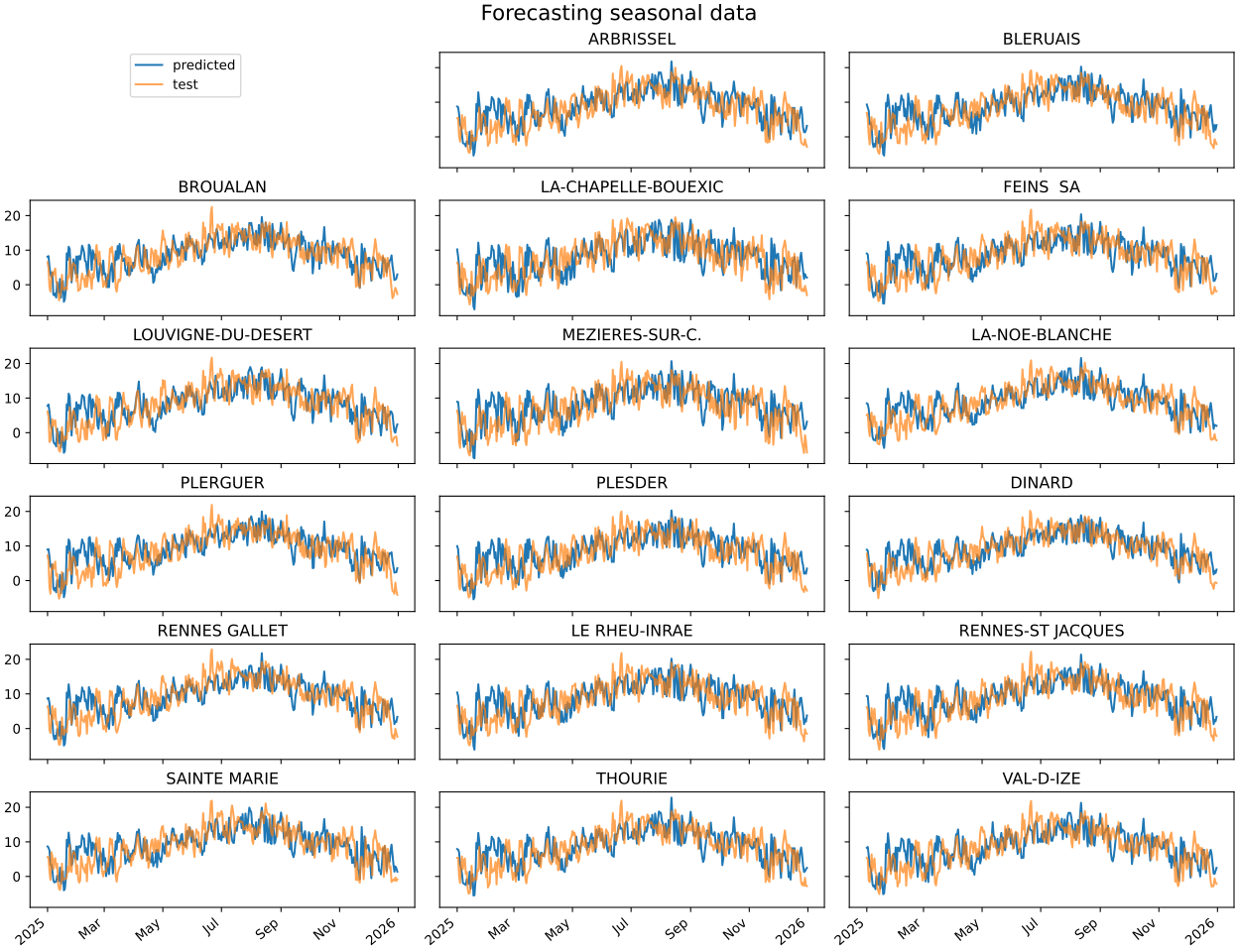
VARIMA and AutoARIMA estimators both allow for seasonally adjusted data. In that case, VARIMA modeling is performed against \(y_t - y_{t-k}\) where \(k\) is the seasonal period.
model = AutoVARIMA(seasonal_period=365).fit(train_data)

horizon = 365
predicted = model.predict(n=horizon)

import math
import matplotlib.pyplot as plt

plt.rcParams['date.converter'] = 'concise'
fig, axes = plt.subplots(math.ceil(len(train_data) / 3), 3, sharex=True, sharey=True,
                         layout="constrained", figsize = (13, 10))
for i in range(len(train_data)):
    j = i + 1
    ax = axes[j // 3][j % 3]
    predicted_plot, = ax.plot(test_times[i][:horizon], predicted[i], label="predicted")
    test_plot, = ax.plot(test_times[i][:horizon], test_data[i, :horizon], label="test", alpha=0.7)
    ax.set_title(test_places[i])
    for label in ax.get_xticklabels():
        label.set_rotation(40)
        label.set_horizontalalignment('right')
fig.delaxes(axes[0,0])
fig.legend(handles=[predicted_plot, test_plot], loc='upper left', bbox_to_anchor=(0.1, 0.95))
fig.suptitle("Forecasting seasonal data", fontsize=16)
plt.show()
Total running time of the script: (0 minutes 38.562 seconds)