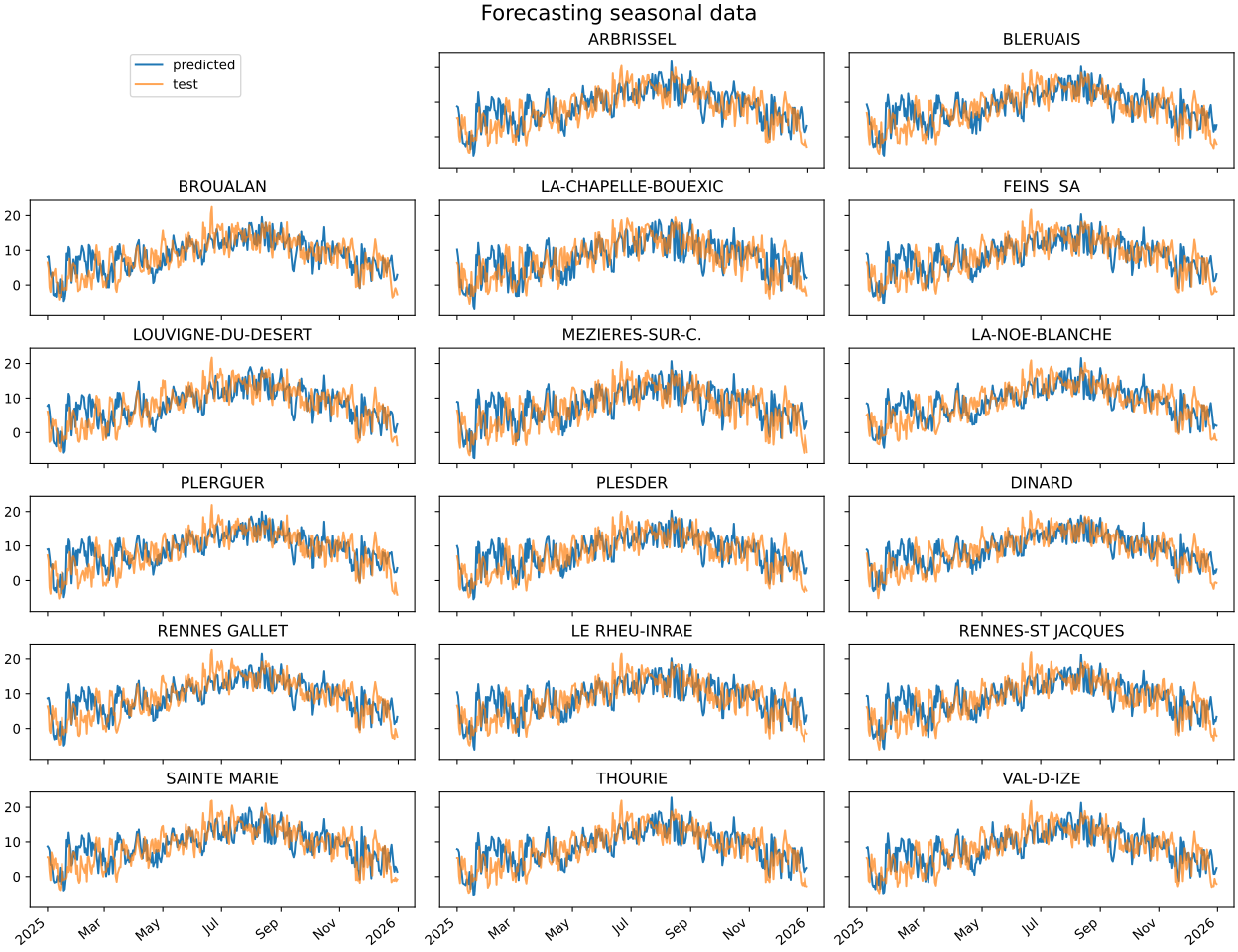
AutoVARIMA#
- class tslearn.forecasting.AutoVARIMA(max_p=5, max_d=2, max_q=5, default_d_for_non_stationarity=0, seasonal_period=None, max_iter=50, verbose=0)[source]#
Automatically selects the best Vector Autoregressive Integrated Moving Average (VARIMA) model through Hyndman-Khandakar algorithm [1] [2].
- Parameters:
- max_pint (default: 5)
Maximum order of the AutoRegressive (AR) component to consider.
- max_dint (default: 2)
Maximum order of differencing considered to achieve stationarity.
- max_qint (default: 5)
Maximum order of the Moving-Average (MA) component to consider.
- default_d_for_non_stationarityint or None (default 0)
Used as differentiation order if stationarity cannot be achieved within max_d. If None, an error is raised if stationarity cannot be achieved within max_d.
- seasonal_period: int or None (default: None)
Naïve seasonal integration to apply to VARIMA models
- max_iterint (default: 50)
The maximum number of iterations to apply to VARIMA models fitting.
- verboseint (default 0)
When set to a positive integer, displays logs of the tested VARIMA models selection process. If set to 2 or more, also propagates verbosity to the VARIMA models.
- Attributes:
- best_estimator_: VARIMA
the fitted VARIMA model.
See also
VARIMAVector AutoRegressive Integrated Moving Average (VARIMA) estimator.
Notes
This estimator supports variable length time-series
References
[1]R. J. Hyndman and G. Athanasopoulos, Forecasting: Principles and Practice. OTexts, 2014. https://otexts.com/fpp3/
[2]Hyndman, R. J., & Khandakar, Y. (2008). Automatic time series forecasting: The forecast package for R. Journal of Statistical Software, 27(1), 1–22.
Methods
fit(X[, y])Selects the best Vector Autoregressive Moving Average (VARIMA) model through Hyndman-Khandakar algorithm for the given data.
fit_predict(X[, y, n])Selects the best Vector Autoregressive Moving Average (VARIMA) model and forecasts n timestamps for the given data.
from_hdf5(path)Load model from a HDF5 file.
from_json(path)Load model from a JSON file.
from_pickle(path)Load model from a pickle file.
Get metadata routing of this object.
get_params([deep])Get parameters for this estimator.
predict([X, n])Forecast with the model selected at fitting time.
set_params(**params)Set the parameters of this estimator.
set_predict_request(*[, n])Configure whether metadata should be requested to be passed to the
predictmethod.to_hdf5(path)Save model to a HDF5 file.
to_json(path)Save model to a JSON file.
to_pickle(path)Save model to a pickle file.
- fit(X, y=None)[source]#
Selects the best Vector Autoregressive Moving Average (VARIMA) model through Hyndman-Khandakar algorithm for the given data.
- Parameters:
- X: array-like, shape (n_ts, sz, d)
Time-series dataset.
- yIgnored
- Returns:
- self
the fitted estimator
- fit_predict(X, y=None, n=1)[source]#
Selects the best Vector Autoregressive Moving Average (VARIMA) model and forecasts n timestamps for the given data.
- Parameters:
- X: array-like, shape (n_ts, sz, d)
Time-series dataset.
- yIgnored
- nint (default: 1)
The number of timestamps to forecast, a.k.a. the horizon.
- Returns:
- array, shape = (n_ts, n, d)
Array of forecasted timestamps
- classmethod from_hdf5(path)[source]#
Load model from a HDF5 file. Requires
h5pyhttp://docs.h5py.org/- Parameters:
- pathstr
Full path to file.
- Returns:
- Model instance
- classmethod from_json(path)[source]#
Load model from a JSON file.
- Parameters:
- pathstr
Full path to file.
- Returns:
- Model instance
- classmethod from_pickle(path)[source]#
Load model from a pickle file.
- Parameters:
- pathstr
Full path to file.
- Returns:
- Model instance
- get_metadata_routing()#
Get metadata routing of this object.
Please check User Guide on how the routing mechanism works.
- Returns:
- routingMetadataRequest
A
MetadataRequestencapsulating routing information.
- get_params(deep=True)#
Get parameters for this estimator.
- Parameters:
- deepbool, default=True
If True, will return the parameters for this estimator and contained subobjects that are estimators.
- Returns:
- paramsdict
Parameter names mapped to their values.
- predict(X=None, n=1)[source]#
Forecast with the model selected at fitting time.
- Parameters:
- Xarray-like, shape (n_ts, sz, d), optional
Time-series dataset to forecast. If None, the fitted data is forecasted otherwise the fitted model is applied to the given data.
- nint (default: 1)
The number of timestamps to forecast, a.k.a. the horizon.
- Returns:
- array, shape = (n_ts, n, d)
Array of forecasted timestamps
- set_params(**params)#
Set the parameters of this estimator.
The method works on simple estimators as well as on nested objects (such as
Pipeline). The latter have parameters of the form<component>__<parameter>so that it’s possible to update each component of a nested object.- Parameters:
- **paramsdict
Estimator parameters.
- Returns:
- selfestimator instance
Estimator instance.
- set_predict_request(*, n: bool | None | str = '$UNCHANGED$') AutoVARIMA#
Configure whether metadata should be requested to be passed to the
predictmethod.Note that this method is only relevant when this estimator is used as a sub-estimator within a meta-estimator and metadata routing is enabled with
enable_metadata_routing=True(seesklearn.set_config()). Please check the User Guide on how the routing mechanism works.The options for each parameter are:
True: metadata is requested, and passed topredictif provided. The request is ignored if metadata is not provided.False: metadata is not requested and the meta-estimator will not pass it topredict.None: metadata is not requested, and the meta-estimator will raise an error if the user provides it.str: metadata should be passed to the meta-estimator with this given alias instead of the original name.
The default (
sklearn.utils.metadata_routing.UNCHANGED) retains the existing request. This allows you to change the request for some parameters and not others.Added in version 1.3.
- Parameters:
- nstr, True, False, or None, default=sklearn.utils.metadata_routing.UNCHANGED
Metadata routing for
nparameter inpredict.
- Returns:
- selfobject
The updated object.
- to_hdf5(path)[source]#
Save model to a HDF5 file. Requires
h5pyhttp://docs.h5py.org/- Parameters:
- pathstr
Full file path. File must not already exist.
- Raises:
- FileExistsError
If a file with the same path already exists.